Soft Skills: The Part of Support You Can’t Document
Good documentation, SOPs, and knowledge bases are a must. They make life easier for you and your team. But if documentation fixed everything, we wouldn’t even be talking about this right now.
But here’s the thing: the hardest part of support work isn’t something you can write down. It’s all about soft skills.
Even with the best docs in the world, teams still run into trouble. If you’re leading a team, it’s on you to make sure everyone has what they need to actually help customers—including those all-important soft skills.
Why Soft Skills Are Harder to Teach Than Technical Skills
Technical skills are pretty black and white. Usually, there’s a right answer and a wrong one.
Soft skills are a whole different story. They depend on judgment, context, and reading the room. What works with one customer might not work with another, and even the way you’re talking—email, chat, phone—can change everything.
That’s why two agents with the same info can have totally different results.
Soft skills might be harder to teach, but that doesn’t mean you can’t teach them. You just have to be intentional about it.
Helping the Customer Is a Soft Skill (Not a Script)
Just because an agent knows the answer doesn’t mean they know how to actually help someone.
There’s a big difference between giving information and actually helping. Real help means the customer feels heard, understood, and like you’re on their side—even if the answer isn’t what they wanted.
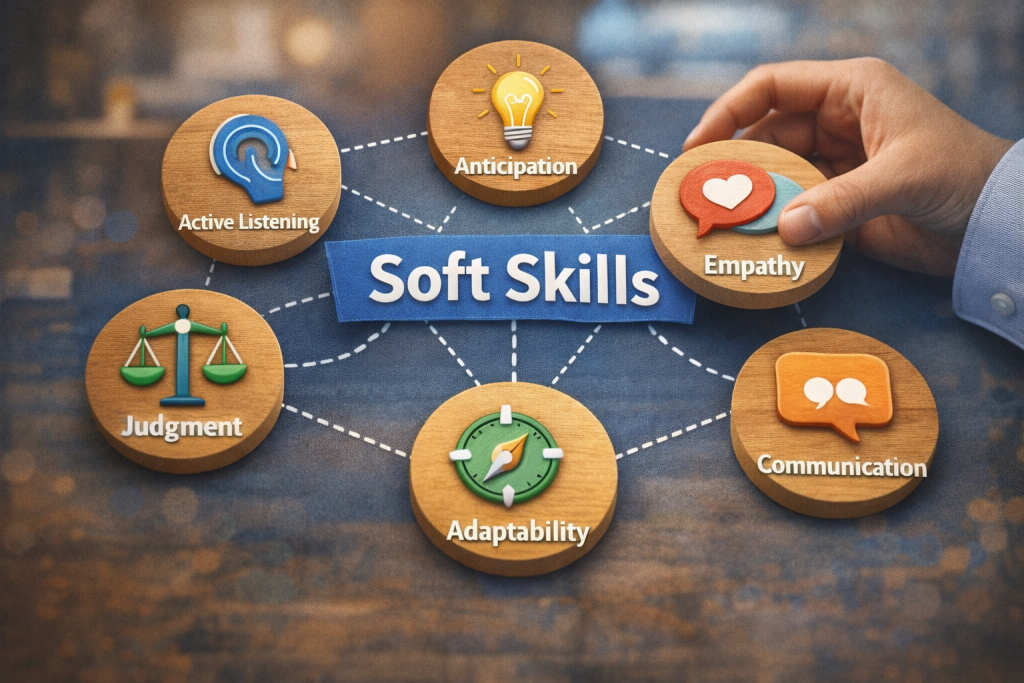
Helping the customer means the agent:
- Understands what’s actually being asked, which sometimes means reading between the lines and uncovering the real problem behind the surface question.
- Anticipates the next question or concern, proactively addressing follow-ups before they arise, and demonstrating empathy for the customer’s perspective.
- Chooses the right tone, pacing, and framing for each individual customer and context, adapting their communication style to meet the customer where they are emotionally.
You can’t script this stuff. It takes judgment, emotional smarts, and a feel for the situation. You don’t get that from a flowchart or a knowledge base article. It comes with practice.
This is where most support training misses the mark. It’s all about technical accuracy and following the process, but it skips the human side. The teams that figure out how to bridge that gap? Those are the ones that really stand out.
Why Documentation Can’t Carry This on Its Own
Docs give agents the answers and the steps, but they can’t replace the human touch. You need real people to read a customer’s tone, calm someone down, or figure out what to do when things get weird. It’s like the difference between following a recipe and being the chef who can make dinner work even when you’re out of eggs.
If your team leans too hard on the docs, you start running into problems like these:
- Overly literal responses: Agents may answer the question exactly as written, missing the nuance or the emotion behind the request.
- Missed context: Without reading between the lines, agents might fail to spot the bigger issue or underlying need driving the customer’s inquiry.
- Inconsistent customer experiences: Every customer is different, and a purely doc-based approach can feel robotic, leading to interactions that don’t adapt to individual needs.
Soft skills are all about feelings, perceptions, and judgment. Docs are black and white. The best teams see that gap and work to close it—on purpose.
You need documentation, no question. But if you want to really help your customers, you have to go past the playbook. Coach your team to use empathy, listen well, and adapt—right alongside their technical skills. That’s what makes support memorable.
Teaching What Can’t Be Documented
So how do you actually teach those tricky, hard-to-pin-down soft skills?
It starts with onboarding that’s more than a checklist—one that creates space for real learning, not just memorization. Soft skills develop best when they’re experienced and demonstrated in action, not just explained in theory.
The most effective ways to teach soft skills include:
- Modeling: Let new team members see soft skills in action. When they observe experienced agents actively listening, showing empathy, and adapting their communication, they learn what “good” looks like.
- Observation: Give new hires the chance to watch real interactions and debrief on what worked (and what could have gone better). This builds their judgment and confidence.
- Feedback: Create a culture where frequent, specific feedback is the norm. Instead of only correcting mistakes, call out moments when someone uses a soft skill well—this accelerates learning.
- Reflection: Encourage team members to regularly reflect on their conversations. What felt natural? What was challenging? What would they do differently next time? Guided reflection transforms experiences into lasting skills.
This is also why onboarding that sticks can’t just be about tools and documentation — it has to create space for judgment to develop. It needs mentoring, peer coaching, and a buddy system. Real relationships make soft skills feel real, not just something you read about. In the end, people pick up soft skills by seeing them in action as much as by being taught.
Mentorship and Modeling as Knowledge Multipliers
The buddy system isn’t just about learning faster. It’s about passing on good judgment. When a new agent teams up with someone experienced, they don’t just learn what to do—they learn how to think through tricky situations, pick up on customer cues, and figure out what to do when the script doesn’t cut it.
A good mentor shows what great judgment looks like in real customer conversations. It’s not just about giving the right answer, but about explaining why they picked a certain tone, how they guessed what a customer was feeling, or when they decided to go off-script to make things better.
This approach helps everyone. The mentor gets better at what they do by teaching it. The new agent picks up real-world wisdom. And the team doesn’t have to worry about everything depending on one person. Most importantly, it’s how you pass on the unwritten rules—how you treat customers, handle tough calls, and show what ‘great’ really means on your team.
That’s how you spread soft skills—not with documents, but with real relationships, stories, and shared experiences that shape how your whole team thinks and acts.
Coaching Soft Skills Requires Systems Thinking
Coaching soft skills means building a place where people are always growing, and feedback is just part of the day. Instead of just fixing mistakes, a good coach looks for patterns—what keeps coming up, what’s working, and where there’s room to grow.
To do this well, your leadership team needs to agree on what soft skills mean for your group. Spell out what things like ‘empathy,’ ‘active listening,’ or ‘ownership’ look like in your world, so everyone’s on the same page. That way, feedback is clear, and everyone knows what’s expected.
If you can’t articulate what “good” looks like in a customer conversation, your team probably can’t either.
Consistent feedback loops are crucial. Build regular moments for feedback into your workflow—not just in annual reviews, but in one-on-ones, peer-to-peer sessions, and quick huddles after challenging cases. Make feedback a two-way street, too, so agents feel empowered to share observations and ideas for improvement.
Another great tool: show your team real examples of ‘good’ and ‘better’ responses. Use real-life situations, whether in docs or team meetings, to make soft skills feel real. Sometimes, just a small tweak can turn an okay customer moment into a great one.
Put all this together, and soft skills stop being mysterious—they become something you can actually teach. When you build these habits into your systems, soft skills become part of your team’s culture, not just a nice idea.
What Great Support Teams Actually Invest In
Great support teams don’t just hope soft skills will show up. They put in the work to build habits and systems that turn good intentions into real actions.
They make time for shadowing and debriefs. New agents don’t just read the manual—they watch experienced teammates in action, then talk through what worked, what didn’t, and why. That’s how you turn experience into real know-how.
They set clear expectations for how to communicate, not just how to solve problems. It’s not enough to fix the issue—agents are expected to make customers feel heard and respected. And they back this up with examples, feedback, and recognition.
They make it safe for people to use their judgment. Team members are encouraged to take smart risks, try new things, and admit mistakes without worrying about getting in trouble. That’s how you build the confidence and flexibility soft skills need.
Leaders stay close to the action. They don’t just look at numbers—they listen to calls, read ticket responses, and pay attention to the human side. That way, they can coach for the stuff that really matters, not just the stats.
Teams that skip this stuff are just hoping for the best. But the ones who put in the time and effort build real consistency, share what they know, and create a customer experience people remember.
Conclusion: Documentation Supports. Leadership Teaches.
Docs matter. Systems matter. But if you want your team to have real soft skills, you need people, time, and a plan.
Soft skills aren’t just a nice bonus for your team—they’re a real advantage. If your customer leaves with answers and feels valued, they’re way more likely to come back than someone who just got a quick answer and felt ignored.
I’d love to hear your stories. What’s the soft skill your team has struggled with most, and how did you handle it? Or have you ever seen documentation fall short for a customer? Share your tips or experiences below—your advice might help someone else out.