
Beyond the Annual Review: The Retention Ladder
When I interview candidates for my support teams, I always ask about their career goals. Support is often a launchpad into the tech world, and it can be tough to know that some team members will eventually move on. Still, I believe it’s best to help them grow and keep them within the company.
The Annual Review always feels like this big, mysterious decision that just drops out of nowhere from leadership. No wonder so many of our best people end up leaving. Coaching and communication build high performance, but they don’t buy loyalty. Without a future, your best agents become your competitor’s next great hire.
If we actually want to do better, we have to quit pretending like career growth is just something we talk about once a year. Instead, we need a clear Retention Ladder. That means having regular coaching and honest conversations, so when a new job opens up, people are already ready for it.
Phase 1: Designing the Retention Ladder Framework
Defining the Career Map
If you want your team to grow with you, they need to see all their options. Honestly, you do too.
Just because someone’s in support today doesn’t mean that’s where they want to stay. Maybe they want to move up in support, or maybe they’re looking at engineering, project management, marketing, or any of the other roles out there. So don’t build your whole retention plan around just support team promotions.
Start by grabbing the official job descriptions for every role in your company. Trust me, this is way easier if you team up with HR.
The Strategic Interview Protocol
Once you’ve got those job descriptions, go talk to people who are actually in those roles. When you do, here are some questions you’ll want to ask:
- What degree/certifications does your job require?
- What does a typical day look like for you?
- What skills aren’t listed that make your job easier? What was the hardest thing you had to stop doing?
- How do you measure success in your position?
- What other teams do you frequently collaborate with?
- If you were just starting your career in this position, what advice would you give yourself based on your experience?
The Career Scorecard: Linking Potential to Performance
Once you’ve got all the info for each job, start building Scorecards. For each one, list out the main skills and responsibilities you found. Figure out what it looks like to not meet, meet, and exceed expectations, based on what people in those roles told you. Make sure your team can actually see these scorecards, so they can track their own progress and spot where they need to improve. And don’t forget to update them with feedback from the folks actually doing the work.
Here is what a scorecard might look like:
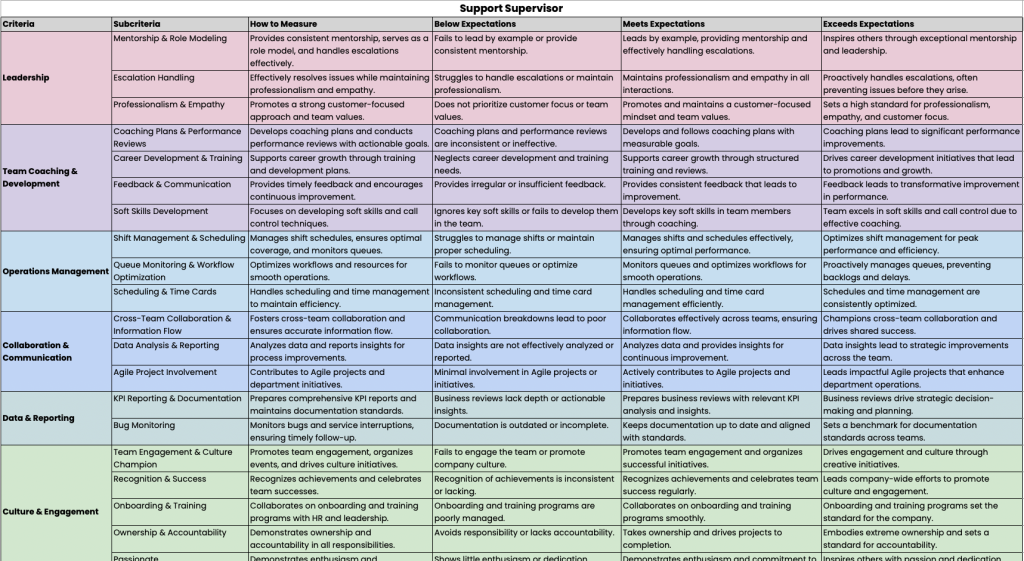
The Scorecard Mandate: Everyone on your team should be able to see these scorecards. And whoever’s running one-on-ones needs to use them during check-ins, based on where the agent wants to go next. They should also serve as the basis for your annual reviews.
Phase 2: Activating the Ladder (The Continuous Check-In)
All that work you put into making these scorecards? It’s wasted if nobody actually uses them.
The Career Scorecard isn’t just a document. It’s your playbook for keeping people around. It only really comes to life in the supervisor-agent Weekly 1:1. That’s the same 30-minute meeting I mentioned in Part 1.
Shifting the Coaching Conversation
If the agent is already doing well, the one-on-one should shift gears. Instead of just talking about what needs fixing or what came up in QA, you should be talking about what’s next for them.
The Readiness Review Protocol
Once an agent is consistently meeting or beating expectations in their current job, the supervisor kicks off the Readiness Review Protocol during their 1:1. This is when the ladder really gets going:
- Define the Target: First, the agent and supervisor need to figure out the next role and where the agent’s skills fit best.
- Gap Assessment: The agent and supervisor should review the target Scorecard together and identify the Top 3 Missing Skills that the agent needs to work on. These must be measurable skills for the new job, not the old one.
- Mutual Accountability:
- Agent Responsibility: It’s up to the agent to chase down the info and learn the skills they need for the job they want.
- Supervisor’s Responsibility: The supervisor’s job is to make sure the agent gets chances to learn or practice the skills they need. For example, if someone wants to be a Project Manager and needs to get better at leading meetings, let them run a team meeting every so often, or even just a part of one. That way, they get real experience and proof they’re ready for the next step.
When you do this, you make talent development part of the supervisor’s weekly routine. It shows your best people that they matter and that there’s a clear path forward.
Phase 3: Scaling Retention (Succession Planning)
The Best Way to Move Up is to Make Yourself Replaceable
When I first started working, I was told to make myself indispensable to keep my job. But I’ve learned the best way to keep moving up is to make sure there’s someone ready and willing to take my spot, so I can move on to my next step.
This is something you want your managers and supervisors to do, too. They should always be on the lookout for someone who could step into their shoes.
In fact, you need to ask them to pick out at least one person who could move into their role. This keeps you from having a single point of failure, makes sure things keep running smoothly, and means your top performers always have a shot at moving up.
Remind them that not everyone wants to be a leader, or would even make a good one. There’s a lot that comes with leadership, and not everyone is up for it. So they don’t have to pick their top agent as their successor. That person might be a technical rockstar and would make a great developer, but the idea of doing a PIP might make them break out in hives.
And you have to do the same! Figure out who on your team could step into your role and start training them. Let them take over one or two of your duties, or work on those things with you. Make sure you’re reviewing the scorecard for your job with them in your one-on-ones, and talk about what could come next for them.
Conclusion
Nobody wants to feel stuck in a dead-end job. Even if someone never wants to leave the support team, they might want to move up to a Tier 2 or Tier 3 agent role.
If you don’t have clear growth paths for your team, it’s way too easy for another company to swoop in and steal your best people.
The Retention Ladder is the real return on investment for your performance system. When you build a clear path forward, you stop hiring replacements and start developing successors.