Indiana Jones and the Fun of Overthinking It
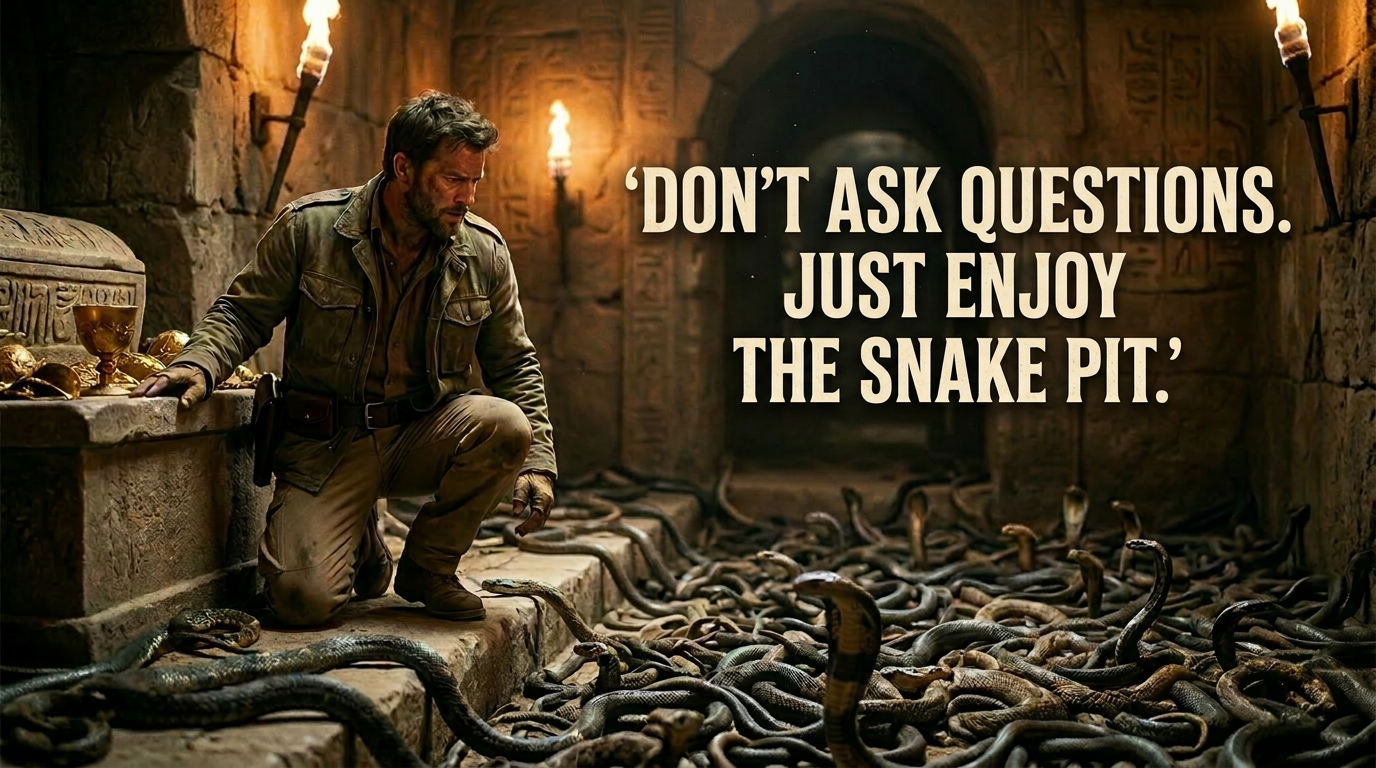
Indiana Jones: Don’t Ask Questions, Just Enjoy the Snake Pit
If you’re a fellow Xennial, you probably grew up on the original Indiana Jones trilogy, too. The newer movies? I could take them or leave them. But those first three? As close to perfection as movies can get. I spent years wanting to be an archaeologist, and it was all thanks to Indy.
A while back, The Big Bang Theory made it a joke to point out that Indiana Jones doesn’t actually change anything in Raiders of the Lost Ark. Fair point. But honestly? That’s not even what bugs me most about the movie. Not by a long shot.
So About That Sunbeam…
Here’s the setup: the whole movie hinges on finding the headpiece to the Staff of Ra, so they can track down where the Ark is hidden. Once they’ve got the staff at just the right length, the sun shines through the headpiece and lights up the exact spot on the map where the Well of Souls is hiding.
They figure out what time of day to look at the map with the headpiece just by checking when the sun shines into the room.
But here’s the thing: the whole plan depends on the sun hitting the headpiece at exactly the right angle. The problem? The sun doesn’t stay put. Its position changes all year long. Unless they just happened to stroll into the map room on the perfect day, at the perfect time, that beam should have pointed somewhere else—or missed completely.
What are the odds they just lucked into the right day?
And if that’s not enough to make your brain itch, The Last Crusade has a couple of moments that make me ask the same kind of questions.
The One Trial That Should Have Stopped Everybody
First up: the three traps guarding the Grail room. Indy stops the spinning blades, tosses pebbles onto the invisible bridge—so the Nazis behind him could probably figure those out. But that second challenge, the one with the stepping stones in the right order? He doesn’t leave any clues for that one.
So how did anyone else get past that? He didn’t mark the path, at least not that we saw. How did they know where to step?
The Grail Logic Is a Little Wobbly
And then there’s the Grail itself.
Elsa Schneider picks a fanciful, gold cup for Walter Donovan to drink from, thinking it is the true Grail. As the Knight says, “He chose poorly.” Indy then selects a cup that looks like it belongs to the son of a carpenter, and he “chose wisely.”
Here’s what gets me: The Last Supper happened in the Upper Room, the Cenacle. Who Jesus was wouldn’t have changed what kind of cup they used.
The movie wants us to see that Indy wins because he thinks humbly and symbolically. A king’s cup would be fancy, but Jesus’s cup would be plain. That’s great for the story. Historically, though? Not so much. The Last Supper was in a borrowed, furnished room, so Jesus being a carpenter’s son doesn’t really tell us anything about the cup.
Temple of Doom may actually be the least defensible of the three if we’re judging purely by “does this make sense?” An inflatable raft somehow works as a parachute, a sled, and a boat; the mine cart chase runs on pure action-movie logic; and an enormous underground cult operation somehow stays hidden beneath a royal palace. None of that stops the movie from being wildly entertaining, but it definitely doesn’t help the “airtight plotting” argument.
Why I Still Love These Movies Anyway
But none of this ruins Indiana Jones for me. Not even close. If anything, it’s part of the fun when you’ve watched a movie a hundred times—eventually, you stop just watching and start poking at all the little details.
The original Indy movies are still endlessly rewatchable. They’re charming, thrilling, funny, and iconic in a way most modern blockbusters just aren’t. But let’s be real—they’re not exactly airtight. Sometimes the plot depends on wild luck, sometimes the logic gets a little shaky, and sometimes that big “aha!” moment falls apart the second you think about it.
And honestly, maybe that’s part of the magic. Indiana Jones was never supposed to be a lesson in engineering, archaeology, astronomy, or ancient dinnerware. It was meant to sweep us up in the adventure. It did. It still does.
I’ll keep watching, I’ll keep loving them, and yes, I’ll keep yelling, “But that makes no sense!” at the screen every single time.