What Happens When an AI Turns You Into a Character Design?
I asked AI to draw me as a character.
Not a polished portrait. Not a glamorous headshot. Not one of those overly filtered “you but prettier” fantasy images.
I wanted the equivalent of an illustrator’s sketchbook page. Messy. Layered. Personal. The kind of page where someone has been studying a character long enough that they stop drawing what the person looks like and start drawing what they feel like.
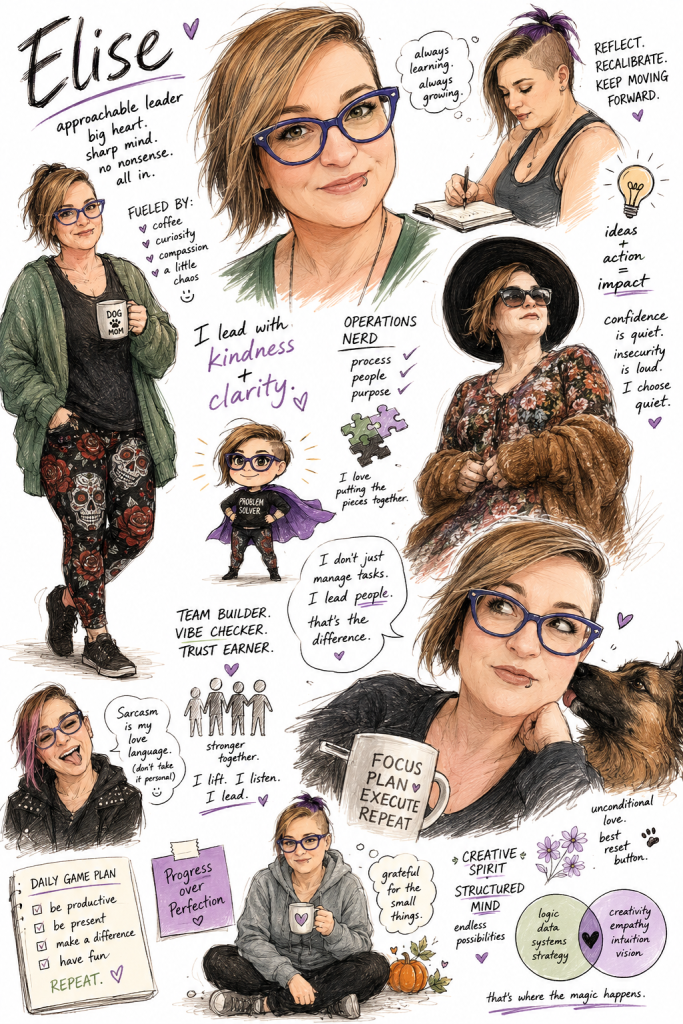
And honestly? The result unsettled me a little.
Not because it was inaccurate.
Because it was weirdly accurate.
The sketch page didn’t just pull from photos. It pulled from patterns. My job. My writing. My humor. My leadership style. My dogs. My feminism. My tendency to swing between deeply structured operational thinking and absolute goblin chaos. The notes scribbled around the page talked about clarity, kindness, rebuilding systems, lifting people up, sarcasm as a love language, and “progress over perfection.”
Which is apparently what happens when a machine spends enough time watching you exist online.
The strange thing is that it didn’t feel like vanity art. It felt observational.
Like seeing yourself through the eyes of someone who notices:
- the emotional support hoodie,
- the brightly colored glasses,
- the “I can fix this process” energy,
- the fatigue,
- the resilience,
- the carefully constructed competence,
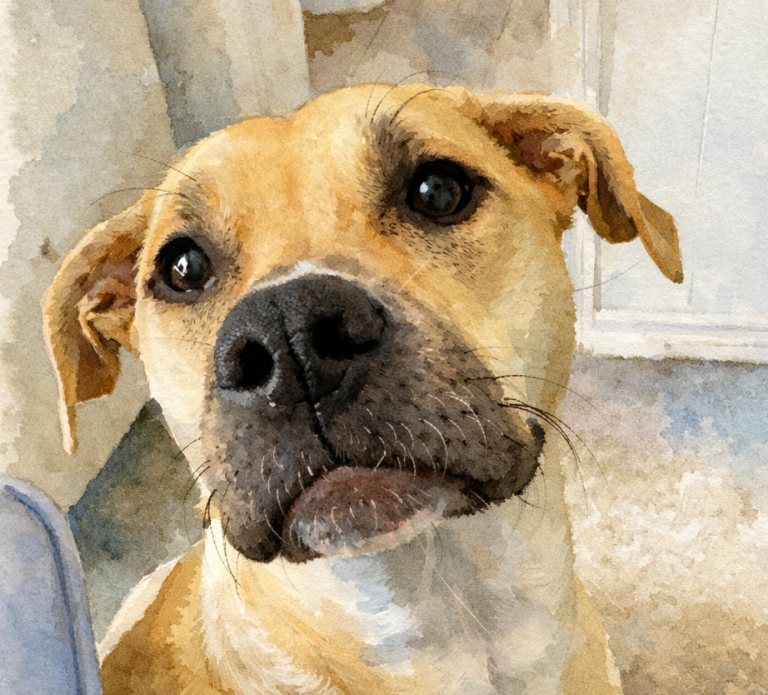
- and the fact that every third photo somehow includes an animal pressed against your face.
It captured contradictions I don’t always consciously think about:
soft but intense,
warm but intimidating,
deeply empathetic but absolutely willing to tell someone they’re wrong,
emotionally intelligent while also powered almost entirely by caffeine and stubbornness.
And maybe that’s the part that stuck with me most.
We tend to think identity is made up of our biggest moments:
career milestones,
major losses,
huge achievements,
transformations.
But what actually creates a recognizable “character” are the repeated small things.
The phrases you use over and over.
The colors you gravitate toward.
The way you solve problems.
The things you defend fiercely.
The jokes you make.
The type of exhaustion you carry.
The people you protect.
The posture you take toward the world.
That’s what the illustration picked up on.
Not just who I am.
How I move through life.
There’s also something deeply funny about realizing that if you leave enough digital breadcrumbs behind, AI eventually concludes:
“This woman appears to survive primarily through operational strategy, dark humor, community care, and dogs.”
Which, honestly, fair.
But underneath the humor, I think there’s something kind of beautiful here too.
Artists have always interpreted people this way. They exaggerate the important parts. They simplify some things and emphasize others until the essence becomes clearer than realism ever could.
That’s what caricature is.
That’s what character design is.
That’s what storytelling is.
And now AI is participating in that process too — imperfectly, strangely, sometimes uncomfortably — by reflecting back the patterns we leave behind.
The result isn’t necessarily “truth.”
But it is a mirror.
A stylized one.
A messy one.
A surprisingly insightful one.
And maybe that’s why I can’t stop looking at the image.
Because it feels less like a portrait of how I look…
…and more like concept art for the person I’ve been slowly becoming all along.