Life Finds a Way (To Break Your Ops): What Jurassic Park Taught Me About Scaling
After spending so much time in support ops, I can’t just watch a movie like a normal person anymore. My brain is always running in the background, picking apart workflows instead of just enjoying the story. It’s a weird superpower I never signed up for. Every time I spot an operational mess-up on screen, I catch myself thinking, “Who thought this was a good idea?”
Nowhere is this more obvious than in Jurassic Park. It’s supposed to be a movie about awe and wonder, but if you’ve ever worked behind the scenes, it’s basically a highlight reel of what happens when you treat operations like an afterthought.
Yes, there are dinosaurs and that unforgettable John Williams music, but if you’ve worked in ops, you know Jurassic Park is really just a giant warning sign. Under all the spectacle, it’s a story about overconfidence and the fallout that occurs when big dreams run faster than the reality of the infrastructure required to support them.
Here is why the park was in trouble long before Dennis Nedry started messing with the computers.
1. Fragile Systems and Single Points of Failure
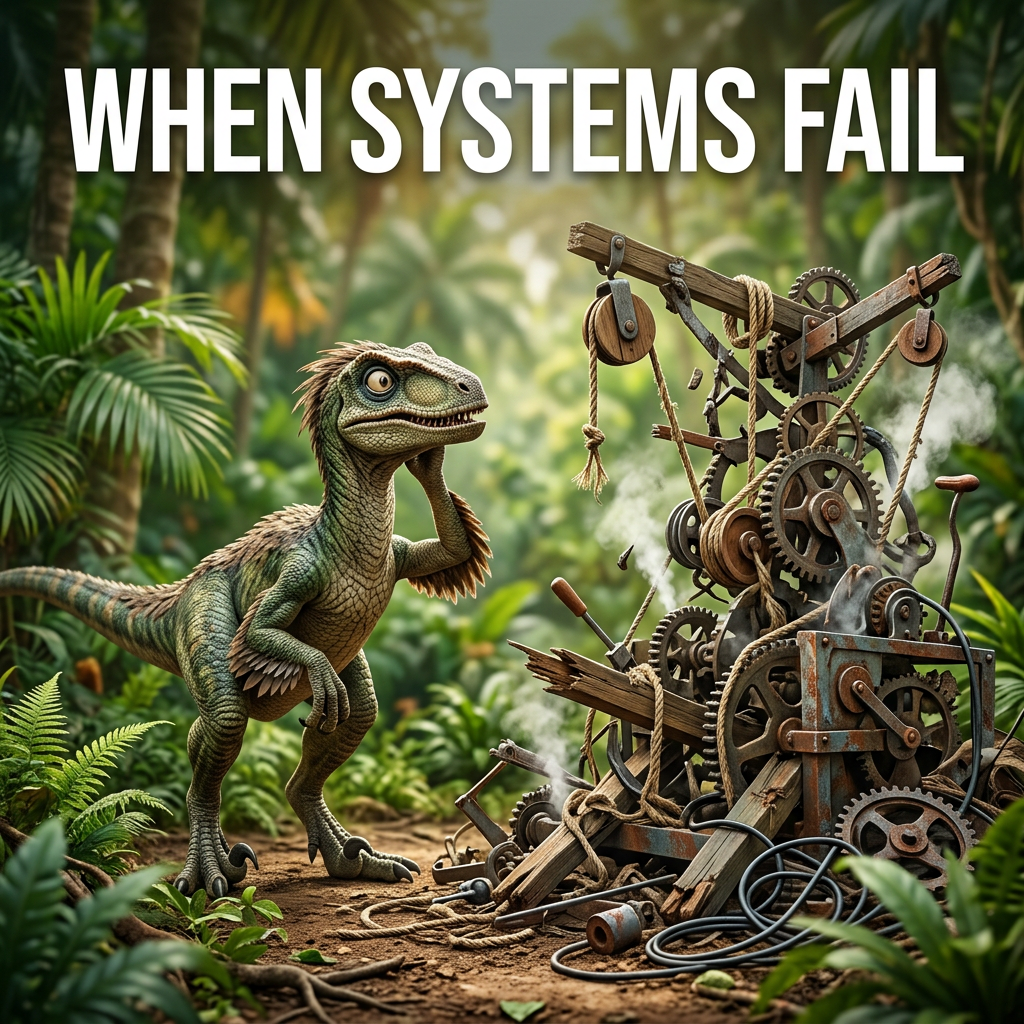
If you’ve ever worked in ops, you know that redundancy is everything. Jurassic Park? Not so much. The whole place ran on one central system, and the only person who understood it was already unhappy. There was no sign of regular audits or failover testing. When Nedry shut things down, there was no backup, no manual override—nothing. They built a system that only worked if nothing ever went wrong. In today’s world, that’s like running your entire business on one server with no redundancy, just crossing your fingers. No ops professional would ever sign off on that.
2. Poor Contingency Planning
Why was the maintenance shed all the way across the compound? And who thought it made sense to put the emergency power reset in a shed, in the middle of nowhere, requiring a manual flip? The lack of automation or remote management is wild—especially when you’re dealing with apex predators. If you’re building something high-stakes, your backup plan cannot be “hope for the best.” You need clear playbooks, runbooks, and teams who know exactly what to do when things go sideways. Jurassic Park didn’t have that; they just had a series of cascading crises.
3. Knowledge Concentration
The park had a massive “Bus Factor” problem. If John Hammond had disappeared—or, as we saw with Ray Arnold, if a key player was…eaten—all the institutional knowledge would have vanished. Documentation was virtually nonexistent, and there was no evidence of cross-training. When you put all your eggs in one or two baskets, you aren’t just asking for trouble; you’re guaranteeing it. Modern ops teams know that true resilience comes from distributed knowledge and empowered teams capable of handling chaos.
4. Leadership Confidence Outpacing Operational Readiness
John Hammond is the classic “big-dream” founder. He has the vision, the money, and the charm to get everyone excited. He believes in his idea so much that he can’t even picture it failing—and that is exactly where things go wrong. He skipped the “boring” stuff: safety protocols, documentation, and proper staffing. There is always pressure to launch fast and impress investors, but if you don’t build a solid foundation first, you don’t get a park—you get a disaster that everyone talks about for all the wrong reasons.
The Bottom Line
In real life, we’re not usually dealing with escaped velociraptors. But the pattern is the same. Whether you’re launching an app, opening a store, or scaling a team, you’ll see the cracks the moment you treat process, people, and documentation as “unsexy” afterthoughts.
Shortcuts might get you to launch day, but they’ll always catch up with you. Your customer experience is only as good as the systems holding it up. You can have the coolest product in the world, but if your ops are shaky, you’re basically just waiting for the lights to go out.
Every time something went wrong in the park, it wasn’t bad luck—it was a failure to sweat the details. The checklists, the drills, and those “what if?” conversations are where real success comes from. Real operational excellence is about patience and preparation. It’s the unglamorous groundwork you do before anyone else is paying attention that determines the difference between chaos and calm.
So, the next time you’re building something new, channel your inner Hammond for the big vision, but don’t forget to call on your inner Arnold to keep the lights on when the T-Rex comes knocking.
A Closing Question for the Readers
I’ve had my fun picking apart the logistics of Isla Nublar, and I’m still haunted by the T-Rex on the boat in the San Diego sequence. (Seriously—the crewmember’s hand was still on the button to close the hatch, but his arm was detached from his body. Did he push the button after his arm fell off?)
How about you? Is there a movie, show, or fictional workplace you just can’t watch anymore without seeing the operational disasters? Let me know in the comments—I’d love to swap some stories.