Gut vs. Scorecard in Hiring: When Your Gut and Brain Fight
When the Scorecard Says “Yes” but Your Gut Hesitates
You’ve finished up all your interviews, scored them, and even talked things over with your interview partner. But then you hit a wall. The numbers are pointing one way, but your gut is waving a big red flag. Welcome to the classic gut vs. scorecard moment in hiring.
This happens to all experienced leaders at some point. But how do you handle this disagreement?
Hiring is always a mix of process and gut instinct. Sometimes, though, those two just refuse to get along. Maybe you’re rooting for a candidate, but the scorecard says no, or maybe the numbers look great, but something just feels off. Either way, you have to decide which voice to trust.
Ignoring this moment—either way—can lead to slow ramps, team friction, or a hire you regret six months later.
Why The Gut vs. Scorecard Conflict Is Normal (and Actually Healthy)
First, don’t beat yourself up over this. It happens to everyone who’s done any real hiring. Honestly, it’s not even a bad sign.
If you’ve been hiring for a while and your gut is whispering (or shouting) something different than the scorecard, it probably means you’re picking up on something you just can’t quite name yet.
That tug-of-war just means you’re thinking things through, not messing up the process.
Learning how to navigate this tension is one of the most important hiring skills a leader develops.
What Your Gut Is Really Reacting To
The first thing to do is figure out what your gut is actually trying to say.
Take a moment, step back, and really think about what’s bugging you. You’ve got to put a name to it.
- Was there a skill gap?
- Were the candidate’s answers good, but something was off with their behavior?
- Did their values align with yours and your company’s?
Ask yourself, “Can I explain this concern clearly to someone else?”
Go Back to the Scorecard Before You Trust the Feeling
Next, you need to return to your interview scorecard.
Go back through your notes, question by question. Were you a little too generous with your scoring in the moment? Did one amazing answer make you forget about the rest? It’s easy to let one great answer—or the last answer—carry more weight than it should.
Let the interview scorecard keep you grounded. It’s not there to prove your gut right or wrong.
Look for Patterns, Not One-Off Moments
Patterns predict performance. Moments don’t.
One great answer shouldn’t make you forget the weaker ones, and one awkward moment shouldn’t send you running for the hills.
You need to look for patterns in their responses.
Things you should look for include:
- Consistency of their answers
- Did they give good, meaningful examples, or were they just surface-level examples?
- When you ask about situations that have gone poorly or wrong for them, did they take ownership of the problem or deflect responsibility?
If you see the same signals popping up in different questions, that’s what really matters.
Use a Tie-Breaker, Not a Veto
Once you’ve figured out what your gut is telling you, use that to decide your next step. Don’t just hit the reject or hire button right away. You need a tie-breaker between your gut and the scorecard.
A tie-breaker adds data to your gut feeling.
Here are a few ways you can break the tie:
- Conduct a follow-up interview.
- Make sure your follow-up interview includes good, scenario-based questions. Try using the STAR Method.
- Do a targeted reference check.
- Talk to your interview partner.
Talking things over with your interview partner is always important, even when your gut and your scorecard agree. But when they don’t, that conversation can help you put your finger on what’s bothering you. Sometimes your partner’s score lines up with your gut, not your own score, and they can help you figure out why.
Remember, in this talk with your interview partner, you both should have independently submitted your scores BEFORE your discussion. Talk about the different scores you both gave the candidate. Make sure you focus on why the scores differ, not on who’s right or wrong.
Tie-breakers help you avoid making snap decisions and keep good candidates in the running.
When to Trust the Scorecard Over Your Gut
Sometimes, you just have to go with the interview score over your gut. But when is that the right call?
If you can’t put your finger on what’s bothering you, or the feeling is just a vague sense of unease, it’s time to trust the scorecard.
If your concerns are more about style or personality than about whether they fit the company culture, trust the scorecard. Growth, difference, or unfamiliar styles can feel uncomfortable without being wrong.
If the candidate keeps showing you they have the skills you need, trust the scorecard.
When to Trust Your Gut Over the Scorecard
There are times when you have to trust the interview score, but sometimes your gut is the one you should listen to.
Go with your instincts when your concerns are specific, repeatable, and role-related.
Go with your instincts if you see behavior that goes against your company’s core values.
Go with your instincts if you know you’d hesitate to defend this hire down the road.
A Simple Decision Framework to Use Every Time
To make these decisions easier, it helps to have a go-to framework you can use every time.
I’ve created a simple flow-chart you can use every time your gut and the data conflict:
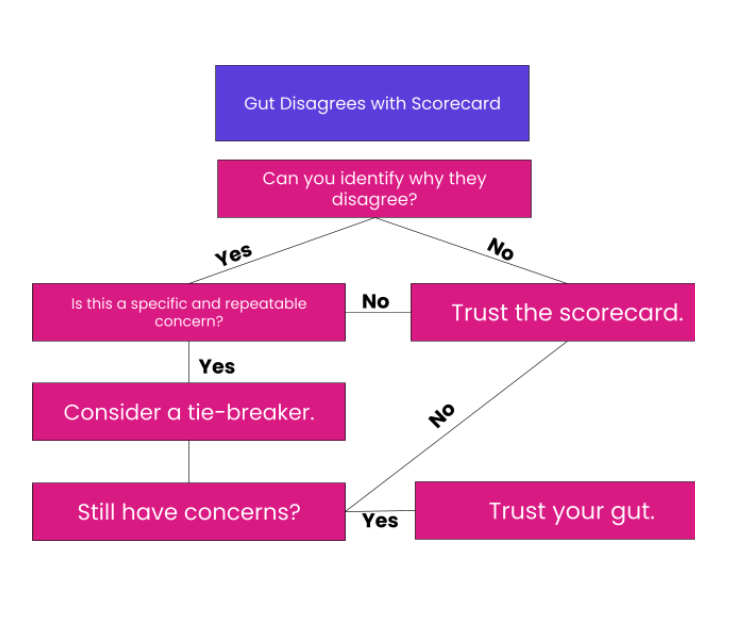
You can use this after interviews, but before extending an offer, as a tool that you work through with your team, or however you’d like.
Structure Doesn’t Replace Instinct — It Sharpens It
There have been times in my career when I’ve hired someone almost entirely on gut instinct, and a couple of times when I went against my gut. I can think of a few people where that worked out spectacularly. And at least a couple of times where it really, really didn’t.
Having a structured interview process has helped me close that gap.
Interview scores help you cut down on bias, but your gut brings in the nuance.
The best hiring decisions use both structure and intuition, on purpose. That way, it’s not gut vs. scorecard, but gut and scorecard working together.
Structure makes your gut smarter, not just louder.