Onboarding That Sticks: Confidence, Connection, and Learning
You’ve built a structured interview process.
You’ve balanced your gut with your scorecard.
You’ve made the offer.
Now what?
Hiring the right person is huge, but it’s really just the beginning. What you do next decides if that great choice turns into a confident, successful teammate, or if everyone ends up stuck in a slow, painful ramp-up.
That’s where onboarding that sticks really comes into play.
What Makes Onboarding That Sticks Actually Work
Learning Isn’t One-Size-Fits-All
Some people learn best by reading. Others need to see it done first. And then there are the people who have to actually try it themselves before anything clicks. If your onboarding only works for one type of learner, you’re leaving a lot of confidence and momentum on the table.
That’s why the first thing I think about when building onboarding that sticks is how people actually learn.
There are (at least) four different learning styles.
- Visual – learns best with videos, charts, infographics, diagrams, and pictures
- Auditory – learns best by listening to material
- Reading/Writing – learns best by reading and taking notes
- Kinesthetic – learns best by doing and interactive content
Most people don’t learn in just one of these ways. If you want your new hire to really get what they need, your training has to hit all these learning styles.
So, make sure your onboarding has a little bit of everything: reading docs (with lots of screenshots and diagrams), watching videos, taking quizzes, and actually getting hands-on with the work.
Why the Buddy System Works (For Everyone)
Next up: the buddy system. I never skip this part.
Call it whatever you want—buddy system, mentoring, shadowing—it doesn’t really matter. What matters is that it’s in your onboarding.
It helps your new folks build confidence and know-how, provides psychological safety, and, honestly, it’s good for your current team, too.
Onboarding Is Coaching, Not Information Dumping
When you pair a new hire with someone who’s been around a while, the mentor isn’t just to watch over the newbie’s shoulder or throw an overwhelming amount of information at them.
They’re there to be a coach and a guide. They should be showing their mentee not just how things are done, but why, so it actually sticks.
They should also help the new person get a feel for the company’s culture—what it really means to be part of the team.
And maybe most importantly, the mentor should be a safe space for the new person. This is the person they can go to with questions, without worrying about looking clueless. This person is their connection to the rest of the team.
Coaching Is How Leaders Are Built
When you ask someone on your team to be a mentor, you’re helping them grow into a leader.
Mentoring stretches people in the best ways. It asks them to step up—to model behaviors, communicate clearly, and anticipate the needs and questions of someone new. As mentors, team members must think not just about what gets done, but how and why it gets done. This shift from ‘doer’ to ‘teacher’ is how you grow future leaders.
It’s also a chance for mentors to build empathy and patience. They’ll find out fast that what’s obvious to them isn’t obvious to everyone, and that different people need different kinds of help. A great mentor switches up their approach, explains things in a few different ways, and checks for understanding instead of just assuming it.
Being seen as a guide or resource builds their credibility with the team and helps them start seeing themselves as leaders, too.
Teaching Is How Knowledge Scales
I’ve talked about the Bus Factor before. Onboarding is the perfect time to make sure you don’t end up with just one or two people holding all the important info. It also quietly reinforces a culture of knowledge sharing, not hoarding.
Here’s the magic: the act of mentoring cements the mentor’s own knowledge and boosts their confidence.
There is something known as the protégé effect.
The protégé effect is a concept in learning that suggests we learn more effectively by teaching information to others, even if those others aren’t necessarily any less knowledgeable. As author Robert Heinlein puts it, ‘when one teaches, two learn’. – Growth Engineering
Having your team members teach a new hire helps cement what they know. Sometimes I’ll even pair up a fairly new employee with the brand-new hire so they can both get a better handle on things.
Clear Structure Reduces Fear (and Mistakes)
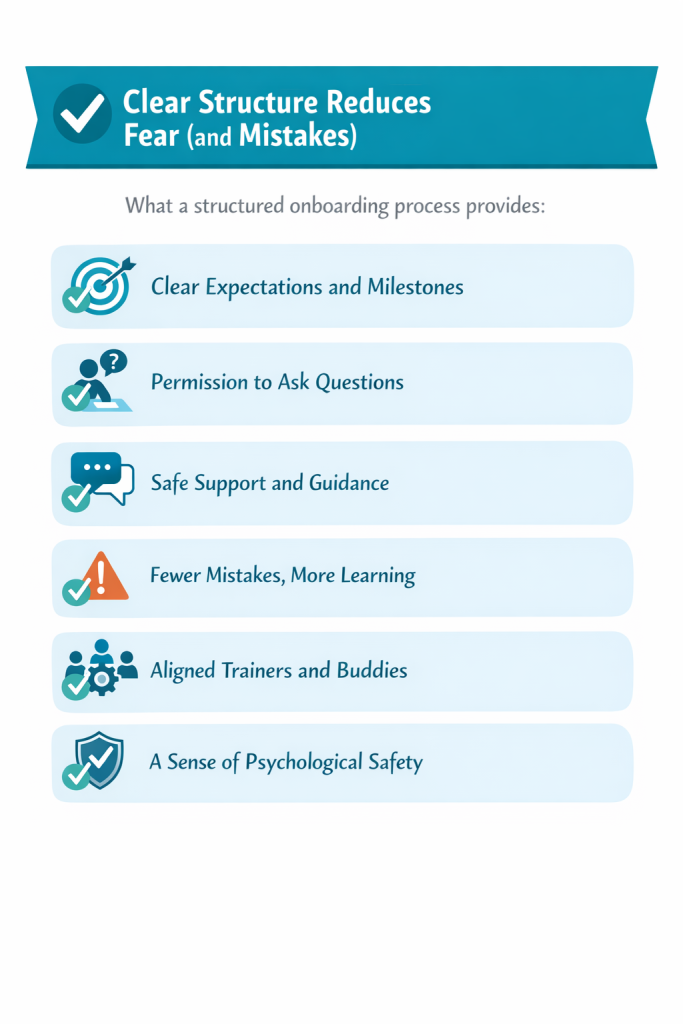
Starting a new job is always a little nerve-wracking. New hires want to do well, but if expectations aren’t clear, that uncertainty turns into hesitation—or worse, guessing.
Clear structure takes away a lot of that fear. When people know what “good” looks like, what they’re supposed to do, and who to ask for help, they get a lot more confident. That confidence means fewer mistakes and faster learning.
Structure also makes people feel safe. When onboarding has clear steps, milestones, and check-ins, new hires don’t feel like they’re supposed to magically know everything. They know questions are expected, progress is tracked, and mistakes are just part of learning—not personal failures.
This kind of structure doesn’t just help the new hire. It protects the team, too. Trainers and buddies aren’t always backtracking or filling in gaps, and knowledge doesn’t get stuck in one person’s head. Everyone knows what’s been covered and what’s coming up next.
The goal isn’t to create a bunch of rigid rules or micromanage. It’s to support people. Good structure gives people the space to learn, ask questions, and build confidence, so mistakes turn into learning moments instead of setbacks.
Onboarding That Sticks Is Where Good Hiring Becomes Great Teams
It doesn’t matter how awesome your new hire is. If you don’t give them the right knowledge, confidence, and support from day one, they’re going to fail.
But when you put real effort into onboarding—mixing structure, mentorship, and a real understanding of how people learn—you set everyone up for success. New hires ramp up faster, make fewer mistakes, and actually feel like they belong. Your existing team gets stronger, too, with more leaders, more shared knowledge, and a culture of trust.
Onboarding that sticks isn’t just a checklist. It’s the bridge between good hiring and great teams. Get this part right, and you’ll see the impact everywhere.
What’s the best (or worst) onboarding experience you’ve ever had? I’m pretty sure we’ve all got stories, so drop yours in the comments.